Discover Your Next
Obsession.

Hi, I’m Allegra. I Love Mahjong.

In mid-2020, American Mahjong was quietly on the cusp of its modern renaissance. As a result of the global pandemic, interest began to spike after a lull following the 1960s. I had come across Mahjong at various times in my life, but had always dismissed it for one reason or another. But, now that life had to pause for a while, I had some time to start exploring Mahjong and to teach myself this incredible game. My early forays relied on whatever digital and written resources existed at the time—mostly dull and dated “how-to” manuals and instructional videos from the distant past. I endured.

Here’s the thing: Mahjong cannot live on a screen or in a book—it lives at the table. It lives in your hands. In the rhythm of the game’s rituals. In the act of gathering. The real lessons—when to pivot, what to pass, how to read the table, the rhythm and etiquette of play—are learned in motion, across the table, tile by tile. You play. You watch. The strategy deepens. The pace quickens (eventually). And somewhere along the way, you fall into the rhythm of the game.

Recently scaling back a fifteen-year career as a trial attorney, I sought some calm, a way to exercise strategic thinking, and a way to bring others into the mahjong fold through a learning experience I now wish had existed when I first fell for the game—modern, lively, hands-on, and rooted in actual table play. Handsy Mahjong was born: a colorful, relaxed, play-first approach to learning Mahjong. Today, Mahjong is having a full-blown cultural moment. People often talk about the “magic of Mahjong”—that spark that ignites when four people sit down, the tiles start moving, and something bigger than the game takes shape. That magic is real and guiding people to it is one of my favorite things.

As an Ambassador with The Mahjong Line, I am thrilled to provide a learning experience with what I believe are the most covetable and enduring Mahjong tiles, racks, and accessories available. Modern American Mahjong is a rich sensory experience—tactile, design-forward, and deeply social. The Mahjong Line is here for all of it.

At Handsy Mahjong, we know that Mahjong is more than just a game—it’s social infrastructure. That sounds big. It is. This game earns every ounce of the hype and intrigue that are synonymous with its name. Get into it.

I look forward to playing with you!

Let’s get Handsy!

Yellow outline of a hand making a peace sign against a black background.

Mahjong is more than just a game;
it’s social infrastructure.

Let’s Get Your Hands In Some Tiles.

PRIVATE LESSON

1 Player
2 Hours

$150/Person

A neon sign of a hand making the peace sign against a black background.
Neon sign of a hand making the peace sign with two fingers extended.

SEMI-PRIVATE LESSON

2 Players
2 Hours

$100/Person

TABLE LESSON

3-4 Players
2 Hours

$75/Person

A neon sign of a hand making the peace sign with two fingers raised.
Neon outline of a hand making a peace sign, peace symbol with two fingers.

GROUP LESSON

5-8 Players
2 Hours

$60/Person

LESSONS

MAHJONG 101

This lesson is for first-time players or those who haven’t shuffled in for a while. Players who are already familiar with game setup and who are competent at recognizing tiles and reading the NMJL Card, should book Handsy Mahjong’s Mahjong 102 lesson.

Ready to finally understand what every it-girl (and her mom) is getting so excited about? Come and get the tea on your favorite new ladies’ night, beach day, game day—any day—social ritual. In Handsy Mahjong’s Mahjong 101 lesson, we’ll take you from “Wait… what’s happening?” to “Wait…one more game!” This isn’t your bubbe’s hushed card table (though we love her). It’s lively, a little cheeky, and designed to get you confidently in the game—fast. In this introductory course you’ll learn how to:

  • Identify all 152 tiles;

  • Decipher the language of the NMJL Card;

  • Set up gameplay and deal tiles with ease;

  • Understand the movements of the Charleston;

  • Identify compatible winning hands;

  • Confidently move through gameplay; and

  • Feel the rhythm, flow, and the intoxicating click-clack momentum of real play.

By the end of Handsy’ Mahjong’s Mahjong 101 lesson, you won’t just know Mahjong—you’ll feel it. The pace. The patterns. The thrill of a hand coming together.

MAHJONG 102

This lesson is for players who already have an understanding of the basic rules of play, who recognize the tiles and are able to read the NMJL Card, and are able to navigate the Charleston. Players requiring a review of any of these aspects of play should book Handsy Mahjong’s Mahjong 101 lesson.

Okay. You’ve got the basics and you’re hooked! You’ve recently completed Handsy Mahjong’s Mahjong 101 lesson and you are itching to get to the table and start cultivating fluidity and strategy in your game. Here is where we start to do that—practice and strategy are what this lesson is all about. In this intermediate course, you will:

  • Nail the mechanics of the Charleston;

  • Begin to utilize pattern recognition;

  • Begin to integrate tile selection strategy;

  • Begin to integrate hand selection strategy; and

  • Engage in guided play of at least two games.

We will start demystifying the most complex aspects of the game. By the end of Handsy Mahjong’s Mahjong 102 lesson, you will feel more confident in knowing when to hold ‘em and when to throw ’em. No panic-passing here!

MAHJONG 103

This lesson is for players who are comfortable with independent play but are seeking guidance in gameplay strategy and decision-making, or reinforcement of other areas of play. Players requiring a review of any of these aspects of play should book Handsy Mahjong’s Mahjong 101 lesson.

Practice makes progress!

Playing more Mahjong will create muscle memory, will deepen knowledge of the NMJL Card, and will reinforce rules and patterns, making them second-nature over time. Pattern recognition is everything in this game and the more you see the more you recognize.

Handsy Mahjong’s Mahjong 103 lesson aims to fortify what was covered in Mahjong 101 + 102, primarily through guided play. However, players may elect to focus this lesson on any particular aspect of gameplay, or may simply elect sideline guidance as they move through independent games. Additionally, though not an aspect of official NMJL Rules or League play, instruction may be given—at the player’s election—on how to play with blanks, according to the most common “house rules” or “table rules,” and strategy relating to blanks.

THE
BIG CARD

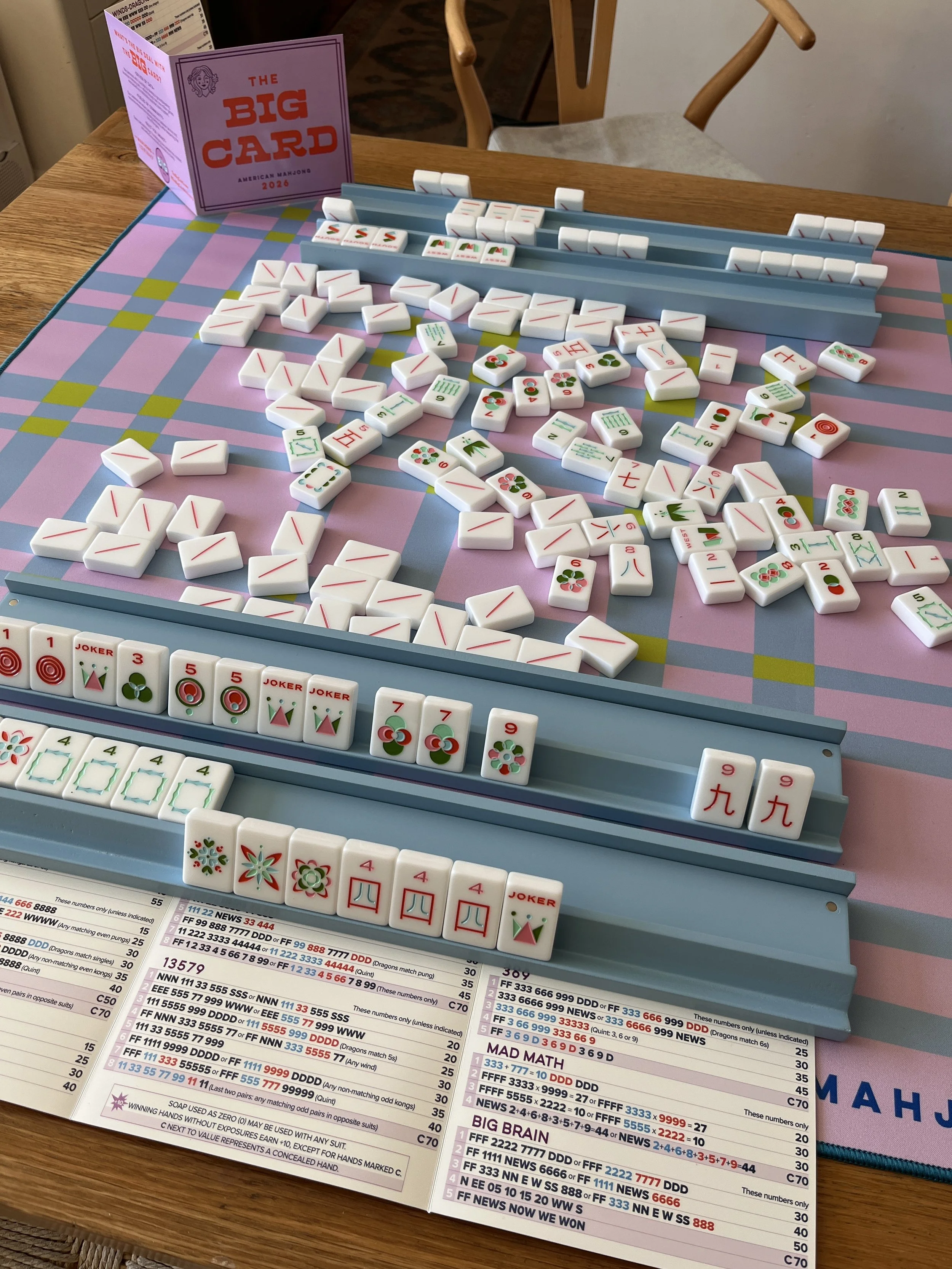
This is a guided play session exploring The Big Card 2026—an exciting alternative (or addition!) to the NMJL Card, while still playing by NMJL Rules. This session is for players familiar with the game and capable of independent play. This session is for groups of four or more players only.

The rumors are true. The Big Card is here and it came to play!

The leading ladies over at the The Mahjong Line teamed up with the developers of the online Mahjong gaming platform, I Love Mahj, along with a host of other Mahjong experts, to create The Big Card—a rigorously tested collection of playing hands, scientifically shown to bring big surprises, big challenges, and big wins! The Big Card gives more, in every way.
It’s big.
It’s fun.
It’s beginner-friendly.
It’s accessible.
It’s philanthropic (30% of card sales are donated to charities!).
It’s research-backed.
(And..it’s just really pretty!)

Come and explore The Big Card in this two hour session of guided play and strategy discussion.

LEARNING SERIES

A graphic illustration of a hand making the peace sign with two fingers raised.

BEGINNERS GROUP SERIES

4 Players

4 Sessions
2 Hours Per Session

$300/Person

Neon sign of a hand making a peace sign with two fingers up.

LIL’ MAHJ MOB

2-4 Players
4 Sessions

1.5 Hours per Session

$240/Person

BEGINNERS
GROUP
SERIES

This is a series of 4 lessons for first time players, including: Handsy Mahjong’s Mahjong 101, Mahjong 102, and Mahjong 103, along with a guided play session for review and further instruction. Must have a four person group.

Let’s get into it! Take the dive with this four class series, which covers Handsy Mahjong’s Mahjong 101, Mahjong 102, and Mahjong 103 classes, as well as continued review and a guided play session. This series will get you firmly on your way to independent Mahj nights with your besties! This series does require a four-class commitment from all four players in your group. (Of course, urgent matters can arise and we’ll roll with it!)

LIL’
MAHJ

SERIES

This is a series of 4 lessons is for players aged 12 and under. We do not have a minimum age requirement, but parents/caregivers are encouraged to consider whether their child is ready for complex gaming concepts and structured 1.5 hour lessons. Please note that a responsible adult is required to be present for the duration of each lesson.

Do you have kiddos who are lusting after your tiles, love a challenge, or just want to get in on the fun? Or, maybe you’re looking to get your mini-me mahjing, so you can get more practice in at home? (So were we!)

We’ve got the answer—Handsy Mahjong’s Lil’ Mahj Mob Series! With the Lil’ Mahj Card, developed by The Mahjong Line, we have taught kids as young as five years-old how to get in the game. Kids learn differently. Instruction in this series moves at a slower pace and the approach is different. Our aim is to have these younger players able to shuffle in with mom and aunties by the end of the fourth session.

AFTER-SCHOOL ENRICHMENT CLASSES

MAHJ MOB

Think young kids can’t grasp and love Mahjong? Think again! We’ve taught children as young as five years-old how to play American Mahjong on the NMJL Card. (And they routinely beat their parents at the game!) Mahjong is an extraordinary exercise in focus, strategy, pattern recognition, memory, and people reading, among other critical thinking skills. From a kid’s perspective, Mahjong is great because the game is different every time and the suspense of not knowing what’s on that next tile is just SO exciting! (Pleeeeeaassseeeee be a Joker!) Beyond this, the game demands respect for rules, engagement, and both game and social etiquette.
Kindness. In a bag of tiles.

We are pleased to offer on campus after-school enrichment classes to students of all ages at schools across the Montecito—Santa Barbara—Goleta region. Please contact us for more information.

Schedule Your Lesson.

Blank white background with no visible objects or details.

We’re excited to Mahj with you!

WHERE?

Handsy Mahjong is able to provide lessons in your indoor or outdoor space—your own living room, patio, private club, HOA club house, a favorite park, the beach, your sorority house, or poolside. We can setup wherever you feel comfortable, inspired, and ready to dive in. We provide lessons throughout the Santa Barbara area: Santa Barbara, Goleta, Isla Vista, Montecito, and Summerland.

WHEN?

Lessons are generally available during daytime weekday hours. But sometimes we also have availability outside of these times. Please include preferred lesson times/dates in your message. We will do our best meet your scheduling needs.

WHAT DO YOU NEED?

We will bring all Mahjong equipment—tiles, mats, racks, cards, etc. Mahjong is most comfortably played on a square or round table that players on all sides can reach to the centre of. We are able to bring a folding table, if one is not otherwise available at your location. We do ask that separate seating for all players be available on site.

Events
that you
will cancel your plans for.

LEARNING
EVENTS

Looking for a party activity or team-building experience that’s a little unexpected—and a lot of fun? Mahjong learning events will give new life to your living room, common room, or boardroom, with laughter, camaraderie, and maybe even some friendly, competitive smack talk (depending on the crowd). Attendees will learn the basics of American Mahjong, working both individually and in small groups to achieve the highly-coveted first Mahjong!

Two-hour long learning events are available for groups of 9-12 players, at a flat rate of $550. For larger groups, please contact us via email.

SOCIAL
EVENTS

Visit www.RivieraMahjSociety.com to learn about regular social play and learning events across the Santa Barbara region. For more info contact Riviera Mahj Society via email.

Let’s
Be Friends.

The origins of American Mahjong date back to 19th-century China, during the Qing Dynasty, when the game was played mostly by men, as they conducted business in teahouses, gambling houses, and social clubs—the boardrooms of the times. The name “Mahjong” derives from the Chinese word for “sparrow,” as the distinct click-clack of shuffling tiles mimic the chattering of these hyper-social birds. (Also a nod to the lively social nature of the game.) The game reached America during the 1920s, sailing back with businessmen who had been taught the game during working voyages to Beijing and Singapore. Joseph Park Babcock is generally credited as having been the first to introduce and market the game to American audiences, publishing the “Red Book” in 1920 (a first attempt at simplifying and standardizing the game in America). The game spread like wildfire during the full-blown cultural craze of the times. Flappers were dancing, jazz was roaring, and soon everyone wanted a Mahjong set in their home. But early American Mahjong was somewhat chaotic, even despite Babcock’s best efforts. Rules were not universal. Hands were not standardized. Even game pieces varied between sets. Every table played the game differently. This ultimately impeded the social networking that helped make the game so popular. If Mahjong was going to survive in America—even in its varied form—it needed an overhaul.

Luckily, in New York in the mid-1930s, Mahjong found an entirely new heartbeat—in the living rooms of women in the Jewish community. The Jewish culture—steeped in tradition, ritual, philanthropy, and community building—lent order to the game, which could only be shared widely to the extent it was played uniformly.  In 1937, a group of these women—led by Dorothy Myerson—formed the National Mah Jongg League (NMJL) and American Mahjong as we know it was born and structure replaced the chaos. Players across the country now followed the same system; just one set of rules. The Charleston took shape—a distinctly American mark on the game. The rhythm solidified. The strategy deepened. What started as a largely male game in Chinese business circles evolved, in America, into a female-led social institution with community and philanthropy at its heart. Mahjong tables became places where women would build the villages they no longer inhabited, exchange news, share parenting strategies, build businesses, raise funds for important charitable causes, support one another, and carve out space in a world that hasn’t always make room for them at the table. This evolution wasn’t trivial. It wasn’t idle. It was strategic, social infrastructure disguised as play. Today, the modern American Mahjong table remains a strategic roundtable of life experience.

Mahjong is strategic and competitive—drawing on memory, mathematical clout, nerve, and of course a little bit of luck, as markers for success at the table. The game teaches pattern recognition, anticipatory response, calculation, and psychological assessment of adversaries. It exercises and strengthens the mind. It broadens social networks and builds quiet power. Because of this, the game was periodically restricted or banned, especially during revolutionary campaigns. Officially, the game was condemned as gambling or bourgeois leisure. Unofficially, however? Games that sharpen strategic thinking, strengthen skills for operating within rigid boundaries, and widen independent networks have a way of making regimes uneasy. Mahjong is badass. Happily, efforts to extinguish the game over the centuries were unsuccessful. Mahjong continued to spread far beyond its earliest hubs and has now evolved to include dozens of variations of the game that are played around the world, each with their own cultural or regional stamp on the Chinese classic. In mainland China, alone, there are more than 30 variants of the game! Old Hong Kong Mahjong is widely regarded as the version most closely resembling the original game—sharing the most characteristics and practices across these many variations. Mahjong enthusiasts everywhere should be sure to spend some time learning, playing, and appreciating this classic version of the game.

Today, the NMJL remains the sole arbitrator for all American Mahjong-related matters—resolving rule conflicts and evolving the game to more modern play. The organization still publishes the official annual card of Standard Hands and Rules—the backbone of American Mahjong. It boasts a membership of over 350,000 and with proceeds of the sale of its annual card, the NMJL has donated millions of dollars to worthy social causes and scientific research over its lifetime. In the wider Mahjong community, philanthropy remains centrally connected to the game, just as the NMJL founders intended.

Have fun.
Do good.

Click.
Clack.
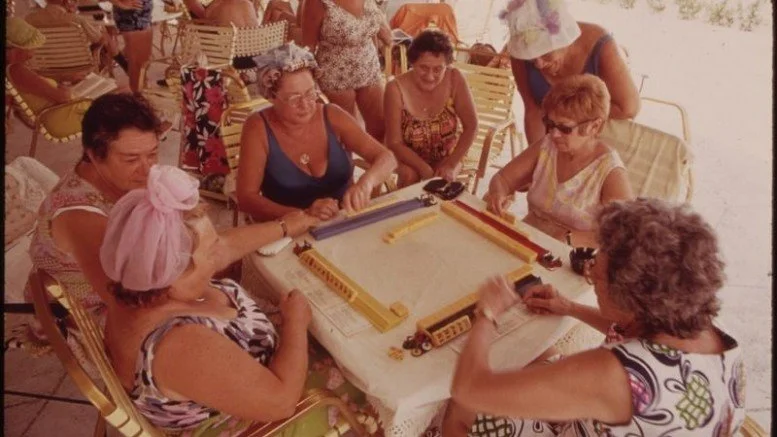
A group of women playing a game of mahjong at a table outdoors, with some women sitting and others standing nearby, in a casual social gathering.

A Brief History of American Mahjong.

A neon-style illustration of a hand making a peace sign, outlined in red with a black background.